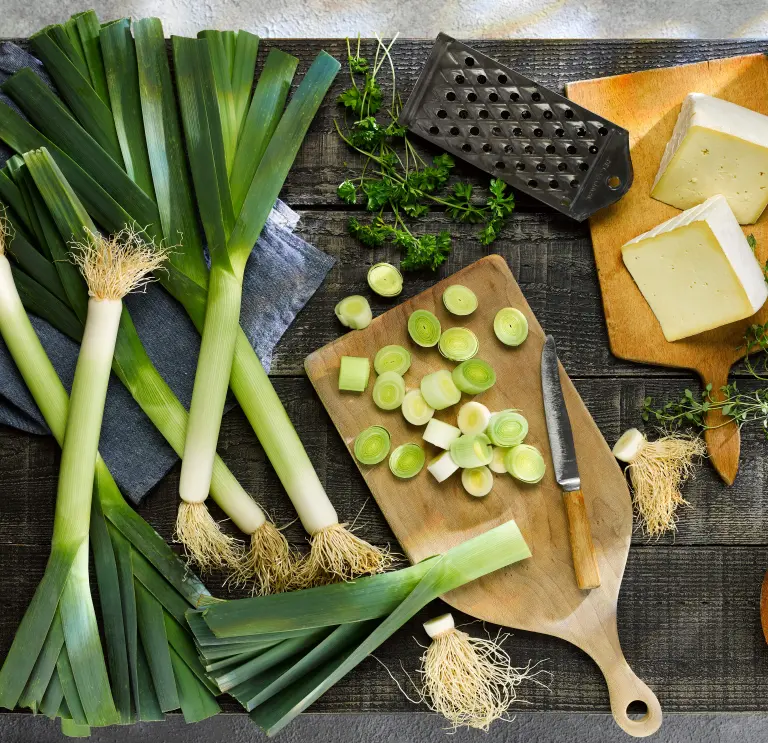
The Welsh leek has been intertwined with the country’s culture for centuries and continues to play a key role in the nation’s cuisine, providing a versatile, delicious yet subtle addition to many dishes. This is down to the slower maturation process, as the milder Welsh - equitable climate means that the leeks can be left in ground without affecting their quality, providing more time for the “peppery” flavour and “earthy, sweet buttery aroma” to fully develop.
The key feature of ‘Welsh Leeks’ is their predominant long distinctive dark green flag which comprises over 40% of the overall length of the leek. The remaining stem is a light fluorescent green that becomes white only within the last 10 – 20mm when in close proximity to the root.
‘Welsh Leeks’ are normally planted from late February through to May and harvested from August through until April/May, with the hybrid varieties used to produce ‘Welsh Leeks’ most suited to Welsh growing conditions. ‘
‘Welsh Leeks’ are also grown as part of a grassland rotation with between 30% and 90% of the rotation under grassland which is used for stock grazing. Leeks require nutrient rich soil, and stock grazing provides the natural fertility and organic matter to the soil for leek growth demanding less reliance on artificial fertilisers.
The Welsh Leek is a part of Wales’ National identity and protecting its status has added another flag in the national vegetable and emblem’s long-standing history.